Music
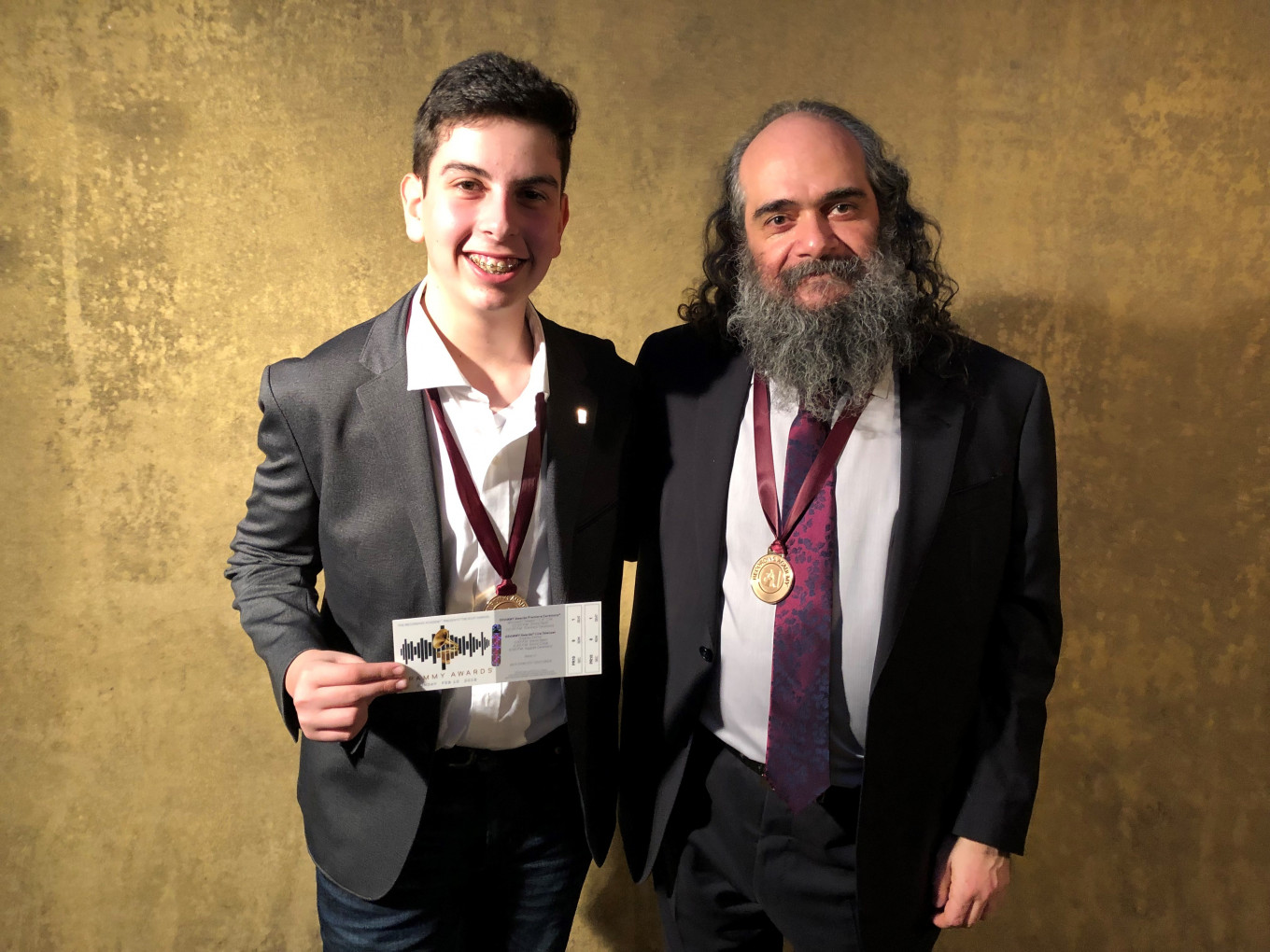
Psoy Korolenko and I at the Grammy Awards in 2019
I am also a singer with musical group Yiddish Glory. We released an album in 2018 called Yiddish Glory: The Lost Songs of World War II, where I sang lead vocals on three of the tracks. The album went on to be nominated for a Grammy Award in the Best World Music Album category in 2019, and we have since toured North America, Europe and Asia.
In 2026, our second album was released. It is called Yiddish Glory: The Silenced Songs of World War II. This album focuses on songs written in present-day Ukraine, Moldova and Central Asia, and challenges the way we understand the Holocaust. I sing track 10 on the album 'Song of Pechera Camp'. You can listen to it on YouTube, Spotify, Apple Music or wherever else you like to stream.
From Anna Shternshis: "Structured as a folk ballad, the song documents some of the most important segments of memories about Pechera, a camp in the Vynnitsia region of Ukraine, designed to kill inmates through starvation. Between 1941 and 1943, about 4,000 people died there (The United States Holocaust Memorial Museum Encyclopedia of Camps and Ghettos, 1933–1945: Volume III: Camps and Ghettos under European Regimes Aligned with Nazi Germany Indiana University Press. p. 743). The camp was operated primarily by local gendarmes. The song depicts one such guard, Lukyan Smetansky, especially known for his mercilessness. Survivors described him as a short, angry drunk, remembered for his brutality, taking bribes and not honoring them, and committing acts of violence against Jews just for fun. In 1945, as the legend goes, he was killed on the spot by a Jewish officer soon after the Red Army liberated Pechera."
At just 12 years old, I joined the Yiddish Glory project, performing lead vocals on three tracks of the 2018 album, Yiddish Glory: The Lost Songs of World War II. One of the pieces I sang was written by a Jewish boy orphaned in the Tulchin ghetto—his family murdered during the Holocaust. Lending my voice to these songs became a way of recovering a history that was almost silenced.
Our album went on to be nominated for a GRAMMY Award for Best World Music Album in 2019, and we have since performed in concert halls across North America, Europe, and Asia—including Toronto, Austria, Germany and Czechia. I have been incredibly fortunate to perform alongside some of the most respected names in folk, jazz, and klezmer music, including Psoy Korolenko, Sophie Milman, Sergei Erdenko, and Sasha Lurje.
Press
My work with Yiddish Glory has been featured in several media outlets including The New Yorker, ABC News, Forbes, The New York Times, NPR, the CBC (TV, “The National” here, radio here and article here), BBC World Service, Globe and Mail, RFI (Radio France International), ORF (Austrian National Radio), Deutschland Radio (German Public Radio), ABC Australia and NRC (The Netherlands). I was interviewed in several outlets including CP24, CBC, The Canadian Jewish News and CTV News.
Background
Yiddish Glory: The Lost Songs of World War II is a 2018 recording of music created during the darkest chapter of European Jewish history. In the midst of World War II, a group of scholars led by ethnomusicologist Moisei Beregovsky (1892 – 1961) discovered songs written by Jewish Red Army soldiers, refugees, victims and survivors of Ukrainian ghettos. One song was written by a 10-year-old orphan who lost his family in the ghetto in Tulchin, another by a teenage prisoner of the Pechora concentration camp, and yet another about a Red Army soldier who learns, upon his return to Kiev, that his family had been murdered in Babi Yar. These were the people, whose voices are rarely heard in reconstructing history, none of them professional poets or musicians, but all at the center of the most important historical event of the 20th century, and making sense of it through music.
Following the war, the researchers were arrested during Stalin’s anti-Jewish purge. The scholars’ works were confiscated, and they died thinking the collection was lost to history. The songs were discovered in unmarked boxes stored in the archives of the Vernadsky National Library of Ukraine in the 1990s.
In the early 2000s, a lucky coincidence brought Yiddish Professor Anna Shternshis to Kiev where she learned that these songs had survived all of these decades following the researchers’ arrests. Quickly deteriorating, fragile documents, some typed, but most hand-written, contained some of the most poignant and historically important Soviet Yiddish songs of World War II.
Many pieces were the first grassroots testimonies of German atrocities against Jews, detailing massacres in Babi Yar, Tulchin, Pechora and others places in Ukraine. Sometimes, composing music calling to fight against fascism was the first thing a person did prior to the invasion by the German Army, and sometimes it was the last act during one’s final moments. The raw emotional ballads convey despair, hope, humor, bravery, resistance and revenge.
Album
The album, released February 2018 is the result of a remarkable collaboration between artist Psoy Korolenko and Yiddish Professor Anna Shternshis. Although some archival documents had their melodies preserved, most were simply lyrics written on small scraps of paper. Psoy Korolenko engaged in “musical archaeology,” and analyzed the scarce supplementary notes, contextualized the lyrics and then took a leap of imagination in order to create or adapt music for the texts. Sergei Erdenko (Russia’s greatest living Roma violinist, founder of the group Loyko) created multi-instrument arrangements and wrote original music for “Kazakhstan”.

Source: yiddishglory.com